To ensure environmental protection requirements are met, the base and walls of the landfill cell must be covered with a waterproofing material, and a drainage system must be installed to ensure the effective collection and removal of leachate.
Landfill waterproofing is necessary to prevent toxic substances contained in landfill leachate from entering the soil.
The TEXPOLIMER Group of Companies is a manufacturer of geosynthetic materials used in the construction and reclamation of municipal solid waste landfills. One of the best-known facilities supplied with innovative materials was the advanced Kaluga Ecotechnopark.
Kaluga Ecotechnopark
The first large-scale project in Russia for the sorting and recycling of municipal solid waste will begin operations at the end of March 2020. More than 1.56 million tonnes of household waste are planned to be delivered annually for disposal across an area of more than 800 hectares. According to the Open Media portal, the largest landfill in Russia today is Timokhovo in the Moscow Region, with a stated capacity of 1.45 million tonnes of waste per year. In other words, Kaluga will exceed it in terms of volume.
Construction of the landfill began in 2018. During this period, the contractor carried out extensive infrastructure development near the facility to ensure uninterrupted construction and subsequent operation of the Technopark, including the construction of roads and the installation of electricity and mobile communication networks. It is emphasised that the Kaluga Ecotechnopark is one of the most modern and high-tech waste reception facilities in Russia. The facility’s sorting complex consists of numerous conveyors with almost no manual labour, while recyclable materials such as plastics, paper and metals are separated using automatic separators.
The site is ready to receive 1.8 million tonnes of waste: 1 million tonnes will be sent for sorting, while 800,000 tonnes will go directly to disposal. Sorting will allow 25% of recyclable fractions to be recovered. This means that 250,000 tonnes out of 1 million tonnes will be converted into secondary raw materials, while the remaining 750,000 tonnes will be sent under bulldozers. Consequently, the total amount disposed of each year will be approximately 1.55 million tonnes.
Why are the residents of Mikhali village opposed to the landfill?
According to local residents, during the Soviet period there was cattle pasture near Mikhali village. The soil here is fertile because groundwater is close to the surface, at a depth of 0.5–2 metres. These figures are given in the 2009 master plan for the development of the Mikhali rural settlement. Of greatest concern is the fact that the area is marshy, which is why it was used for pasture rather than agricultural fields. Residents fear that the waste could contaminate the groundwater. The Trubenka River originates directly within the landfill site and flows into the Shanya River, then into the Ugra and Oka rivers. However, during the assessment, environmental experts did not consider the marshy terrain to be hazardous: the assessment established the actual groundwater level at the time. In addition, a natural impermeable clay layer was discovered near the village. This additional natural waterproofing protects groundwater from foreign substances. Residential buildings are also excluded from the sanitary protection zone: the nearest residential building is more than three kilometres away.
All required standards have been met
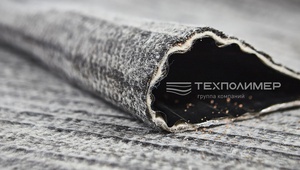
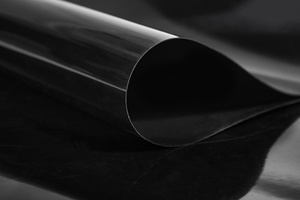
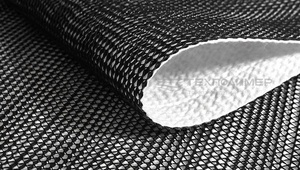
The cells or zones for placing non-recyclable residues are protected by three layers of TEXPOLIMER geosynthetic materials: bentonite mats, a geosynthetic membrane and a 3D drainage mat.
The bentonite clay mat is completely watertight. It consists of bentonite clay granules positioned between two layers of geotextile. The advantages of this material are that it is equivalent to 1 metre of clay waterproofing and has the ability to “self-heal”, meaning that any damage or tear seals itself. In addition, the bentonite mat is highly resistant to weather changes and withstands hydrostatic pressure of up to 6 atmospheres. The second layer is a geosynthetic membrane only 2 mm thick. A geomembrane is a thin yet very strong material that is completely watertight. The membrane sheets are fused together to form a kind of basin, from which water is removed to treatment facilities through the drainage system. The entire placement area is completely covered with geosynthetic materials. This prevents all precipitation, rainwater and meltwater from entering anywhere other than the treatment facilities. This technology is unique in Russia.
Modern treatment facilities and a specially designed protective screen prevent atmospheric moisture runoff from entering groundwater. The quality of the water treated at the Kaluga Ecotechnopark treatment plant makes it suitable for stocking with live fish.
Site reclamation
The facility is designed to operate for 6–7 years, after which a reclamation project will be launched: a set of measures for the environmental and economic restoration of the land. The TEXPOLIMER reclamation system is one of the most effective and safe solutions for conserving such landfills. It includes preventing the formation of landfill leachate, reducing biogas generation, protecting groundwater from contamination and reducing pollutant emissions into the atmosphere. Grass, shrubs and trees are planted at reclaimed municipal solid waste landfills.
This article uses materials from the Open Media internet portal and Lenta.ru.