Results of a study on the effectiveness of composite geodrains in transverse drainage slots during the repair of frost-susceptible sections of roads.
Frost heave refers to deformations of road pavements and the subgrade that occur during winter as surface upheaval and loss of pavement smoothness, and during thawing, when vehicles pass, as breaks in the pavement caused by reduced strength of waterlogged soils.
External signs of frost-susceptible areas in winter include uneven uplift of sections of the road surface, surface upheaval in individual areas, or the formation of groups of upheavals extending across the carriageway with varying intensity. A significant proportion of these areas generally have a network of cracks concentrated around the tops of the frost-heave mounds, which split the pavement into separate pieces of different sizes and shapes.
Frost heave may develop both across the width of the carriageway and along it. Sometimes, frost heave develops more extensively on the shoulders, and their uplift may be greater than in the carriageway area. In spring, after the snow has melted, wet spots may appear on frost-susceptible sections. Fine particles of the drainage layer or subgrade soil may sometimes emerge with the water, and wave-like movements of the road structure may also occur when vehicles pass over it. These sections generally have significantly reduced strength and deteriorate rapidly, resulting in potholes, settlements, etc.
Geodrain classification
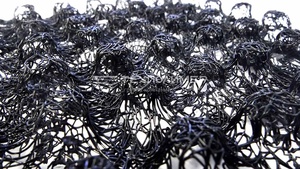
Measures to reduce frost heave during road repair and construction include installing various drainage systems, drainage and reinforcing layers within pavement courses, waterproofing the shoulders and subgrade, increasing embankment height, and replacing the soil. Today, many different drainage geocomposite materials are available. They have in-plane water permeability up to an order of magnitude higher than that of mineral drainage materials or nonwoven geotextiles. Their use ensures faster drainage of road structures, improving the physical and mechanical properties of soils and strengthening road structures.
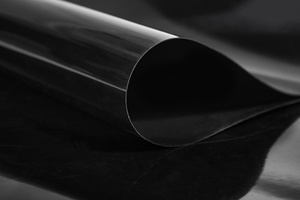
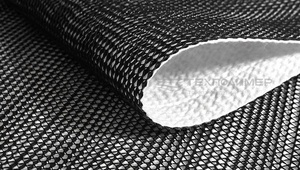
Geodrains can be classified according to the type of geosynthetic material used in the drainage core as follows:
- with a geogrid framework;
- with a profiled geomembrane framework;
- with a geomat framework.
Geodrains with a rigid three-dimensional framework are more effective because external loads have little effect on their in-plane water permeability.
What the test section showed
In summer 2015, at the initiative of the Federal State Institution “Federal Motor Roads Administration ‘Sibir’”, OAO “Novosibirskavtodor”, with the support of SibADI and ZAO “TEXPOLIMER”, constructed a test section during the repair of the M-51 “Baikal” road, km 1000+000 — km 1018+000. The test section replaced “traditional” transverse drainage slots filled with crushed stone (Fig. 1) with a design incorporating layers of drainage geocomposite mat (Fig. 2).
The purpose of constructing the test section was to improve the performance of the drainage slots by introducing a drainage mat with water-discharge characteristics significantly exceeding those of inert materials. The main physical and mechanical properties of the “Hydromat 3D” drainage mat according to STO 56910145-005-2011 are given in Table 2.
Several months after the installation of the two types of drainage slots, the “traditional” type and the type using geodrains, these structures were tested. During a visual inspection near the geodrain outlet, the subgrade soil was wet, demonstrating that the drainage mat was functioning properly. In contrast, in the outlet area of the slot with crushed-stone filling, the soil was dry.
The slots were tested as follows. A pit was excavated on the shoulder in front of the drain, and an empty reservoir was installed below the slope at the outlet. A specified quantity of water was then passed through the drainage system. The test results are summarised in Table 3.
The water poured into the crushed-stone drainage slot completely seeped into the subgrade, demonstrating the ineffectiveness of this design, since the primary function of drainage is to remove water from the lower pavement courses in order to reduce frost heave.
Factory-manufactured geocomposite drainage slots have guaranteed performance parameters, which increases their reliability. The quantity of traditional inert materials used and the requirements for them are reduced, while construction efficiency is improved. In addition, comparison of the estimated costs of the drainage-slot options shows that the use of geodrains can deliver cost-efficient results (Table 4).
In certain applications, it is possible to reduce the subgrade height specified based on the requirements of Table 7.2 of SP 34.13330.2012, and to reclassify the terrain type by nature and degree of moisture from the second or third category to the first, with a reduction in the design moisture content of soils in the working layer of the subgrade (geodrains in the lower part of the subgrade).