Publication «Kommersant», Southern Urals, 06.10.2021
At a meeting between Russian President Vladimir Putin and members of the Government, Deputy Prime Minister Viktoria Abramchenko reported to the President on the completion of the remediation of the Chelyabinsk municipal landfill. The large-scale environmental project was completed ahead of schedule. Implementation of these plans had a significant impact on the overall environmental situation in the regional centre.
In January, Viktoria Abramchenko (centre) visited Chelyabinsk and personally inspected the progress of the landfill remediation.
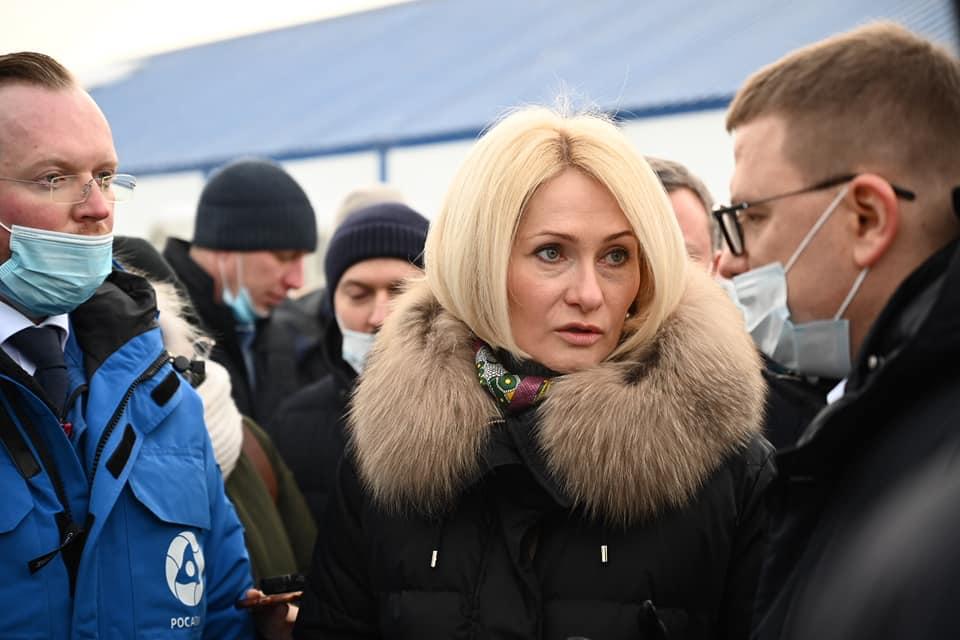
Photo: Press Service of the Government of the Chelyabinsk Region.
On 5 October, Russian President Vladimir Putin held a videoconference meeting with members of the Government. During the meeting, Deputy Prime Minister Viktoria Abramchenko spoke about the completion of the Chelyabinsk municipal landfill remediation project.
The Deputy Prime Minister emphasised that the landfill was Europe's largest waste disposal site located within city limits. It contained 17.5 million cubic metres of waste, which had been brought to the site since the middle of the last century. The landfill's capacity was exhausted as early as 1980, but waste was in fact brought there until 2018.
The remediation of the landfill reduced atmospheric emissions in the regional centre by 30%.
«It is now a green, safe area. A week ago, city residents held sports events there. Thanks to the measures taken, the work was completed ahead of schedule. I would like to thank Chelyabinsk Region Governor Alexey Leonidovich Texler, Rosprirodnadzor and the contractor responsible for this work — “Rosatom” for their prompt work, effectively operating in a task-force mode».
The Chelyabinsk landfill became the largest remediation site in Russia by area. The work was carried out from 2019 to 2021 as part of the federal project «Clean Country» (the national project «Environment»). The contractor was a subsidiary of the state corporation «Rosatom» — FSUE «Federal Environmental Operator». As a result of the remediation, 74.5 hectares of land were returned to beneficial use. In addition to the significant positive effect on ambient air quality, leachate discharges from the landfill were completely stopped, preventing contamination of water and soil.
Vladimir Putin noted that the federal authorities had allocated more than RUB 4 billion for the landfill remediation project.
«This money was used to safeguard the fundamental interests of residents, protect their health and create a favourable environment. Money spent on this is worthwhile»,— the President said.
Earlier, speaking at a session of the St Petersburg International Economic Forum entitled «Environmental Problems Today: Who Will Pay Tomorrow?», Alexey Texler called the remediation of the Chelyabinsk landfill a landmark event for Chelyabinsk. He added that the project had reduced total annual emissions by almost 63,000 tonnes. The regional governor noted that the next landfill to be remediated would be in Magnitogorsk.
It is planned that the design documentation for the remediation of the Magnitogorsk landfill, covering 37.5 hectares and containing 3.7 million cubic metres of waste, will be prepared by the end of 2022, with the work to be completed by 2024. Waste will no longer be allowed to be brought there from the beginning of 2022.
Comprehensive work is under way in the Chelyabinsk Region to improve the environmental situation. According to data from the Russian Ministry of Natural Resources published in the draft state report «On the State and Protection of the Environment in the Russian Federation in 2020», Chelyabinsk ranked first for reducing emissions into the atmosphere from stationary sources (industrial enterprises): its figure for the previous year decreased by 13.04% compared with 2019 (–18.2 thousand tonnes). Magnitogorsk ranked second, with emissions decreasing by 9.56% (–19.6 thousand tonnes). Four-party agreements on reducing emissions and improving the environment have been signed with major industrial enterprises in the Southern Urals. In addition, the governor signed 33 additional bilateral environmental agreements with manufacturers.
According to the Chelyabinsk Region Ministry of Ecology, pollutant emissions in the region decreased by 108.3 thousand tonnes over three years (by 17.7% in 2020 compared with 2017). This result was largely achieved through the modernisation of production facilities. The region was the first in Russia to adopt a regional environmental standard — a set of rules and recommendations for enterprises and organisations aimed at improving the environmental situation in the Southern Urals.
Original article https://www.kommersant.ru/doc/5019095