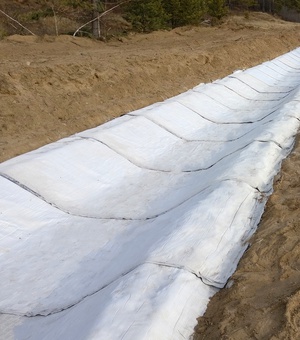
Engineering Protection of Territories and Structures Using «TEXPOLIMER» Concrete Canvas
Author: Konstantin Gorkov – Head of the Engineering and Technical Center of the «TEXPOLIMER» Group.
Abstract. The technology of engineering protection for territories and structures using concrete canvas is presented. Its technical characteristics are outlined, the installation procedure is described, and examples of concrete canvas applications at specific facilities are provided.
Keywords: reinforcement of engineering structures, erosion protection, protection of slopes and watercourse beds, flood protection, water drainage, structural strengthening, facility repair.
Introduction
At present, with the intensive development of territories and the construction of buildings, structures and infrastructure facilities, safety is one of the key considerations in the design and construction of any facility. One important condition for facility safety is the engineering protection of territories, aimed at preventing and reducing the adverse effects of the environment and hazardous engineering-geological processes.
The search for technical solutions for reliable and durable protection is a relevant task in both research and industrial activities.
Concrete canvas
TEXPOLIMER Group offers a new technology for the construction and reinforcement of structures – concrete canvas (STO 56910145-025-2017). This is a modern, cost-effective solution with a number of advantages compared with traditional technologies using precast and cast-in-place concrete structures.
Concrete canvas is a multilayer geocomposite material containing a dry fine-grained concrete mix; depending on the material type, its thickness may be 5, 8 or 13 mm («TEXPOLIMER» Concrete Canvas T5, T8 and T13).
The geotextile layers securely retain the concrete mix inside the material and ensure uniform moisture distribution during hydration, prevent cracking and provide structural stability.
The material hardens after being wetted with water and forms a strong waterproof layer. Within 24 hours, it reaches 80% of its design strength, becoming a monolithic concrete structure.
This technology is a ready-to-use construction solution, so there is no need for additional materials, heavy-duty special equipment or expensive machinery. As a result, it significantly reduces the estimated project cost and shortens the construction period.
The material has demonstrated excellent performance in all climatic zones of Russia: according to tests, concrete canvas does not support combustion (flammability group G1), withstands at least 300 freeze-thaw cycles, is resistant to temperature fluctuations, frost heave of soils and aggressive environments, is not damaged by UV exposure and is only slightly prone to cracking throughout its service life.
Applications of concrete canvas
Concrete canvas is used to construct new structures and protect existing ones, addressing a wide range of tasks, including:
- repair and construction of water bodies, drainage channels and lagoons;
- reinforcement of slopes, hillsides and embankments, protecting them from erosion;
- construction and reinforcement of artificial structures (bunds, dams and reservoirs);
- protection of pipelines, supports and pipe outlets
- repair of concrete structures
- creation of rapidly assembled protective and waterproofing structures and coverings for emergency restoration works.
Concrete canvas installation process
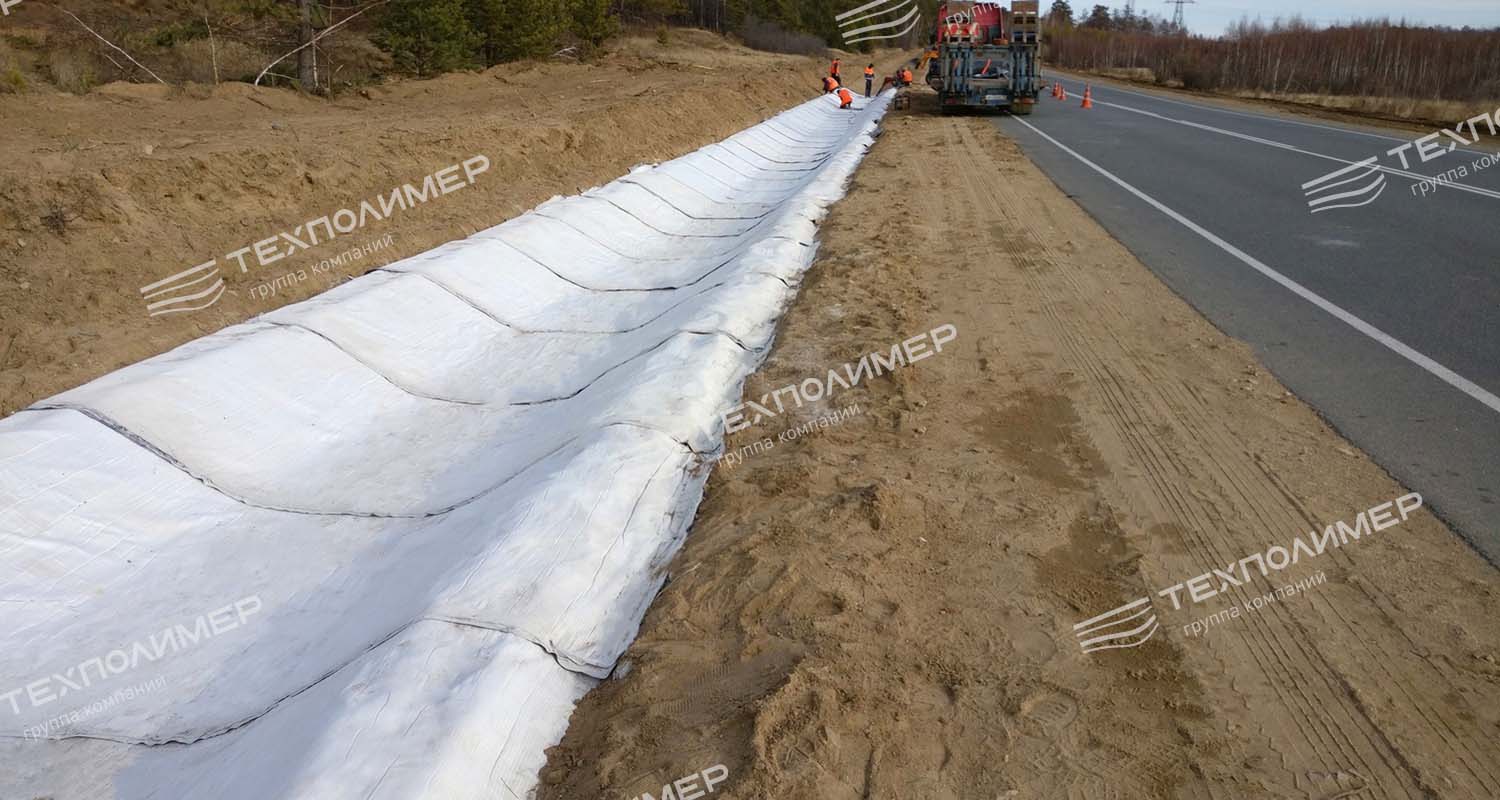
The material is supplied in compact rolls. Concrete canvas can be installed manually; over large areas, it is unrolled using a loader or mobile crane fitted with a spreader beam carrying the roll.
No additional equipment for preparing the concrete mix is required when working with the canvas. This allows the material to be installed in hard-to-reach areas where access and the positioning of heavy construction equipment are difficult.
Before installation, the base is prepared by levelling the soil layer to remove sharp inclusions and prevent damage to the waterproofing coating.
The material is laid longitudinally or transversely with overlaps. The sheets are anchored to the soil, while self-tapping screws are used to fasten them to one another. Importantly, due to its flexibility, unhardened concrete canvas conforms to any surface shape.
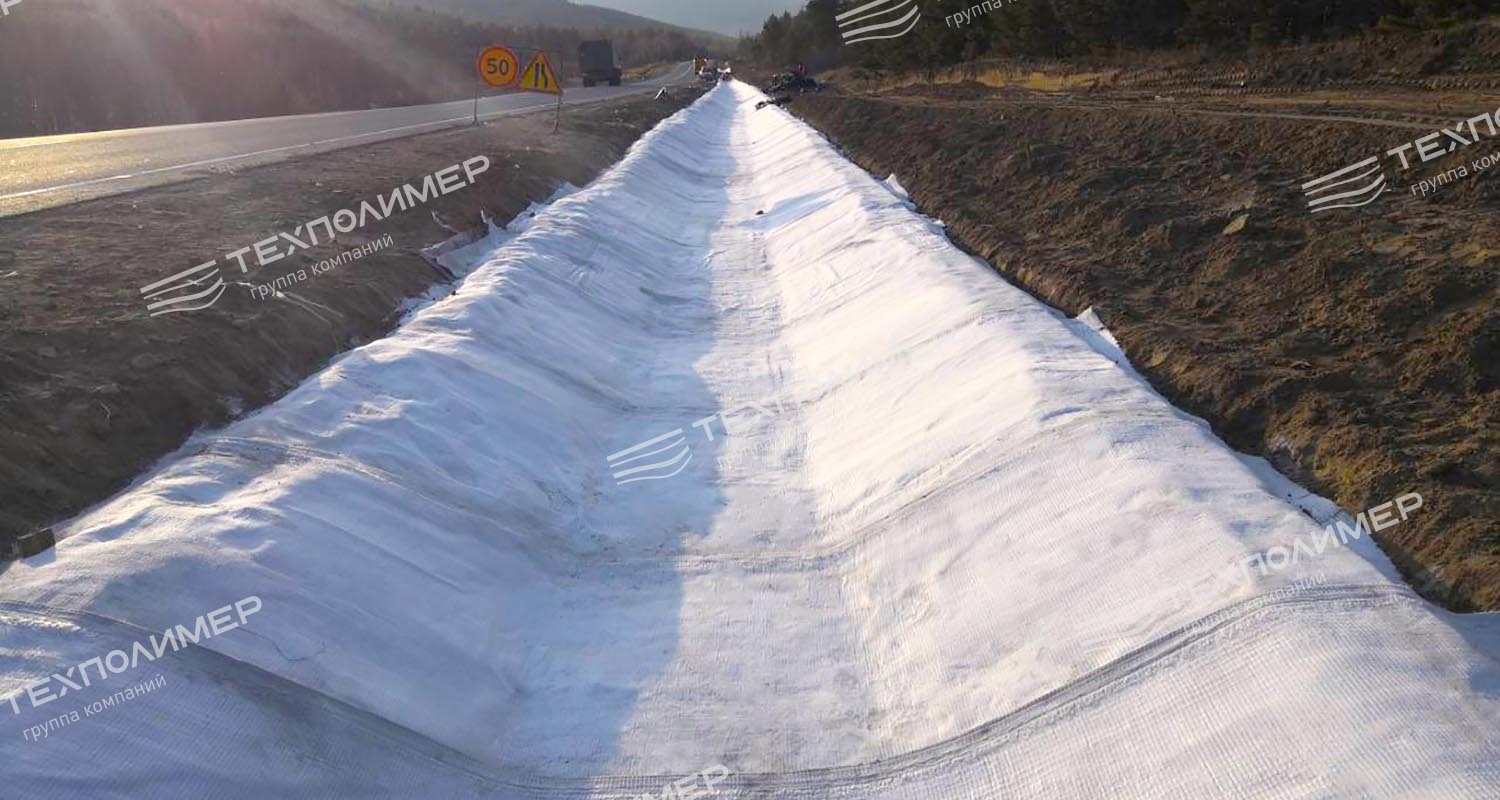
Examples of concrete canvas applications.
Restoration of reinforcement in a road drainage ditch
In 2018, works were carried out to reinforce a drainage ditch on the federal public road Chita–Zabaikalsk–border with the PRC, km 20+471 to km 22+000. Since the concrete canvas was installed during the cold period (October–November), at an average daily air temperature of 0°– +5°C, temporary heated enclosures and other heat-saving structures were installed to ensure setting of the concrete mix.
Before installation began, the bottom and slopes of the drainage ditch were graded, followed by filling the sloped section with fine-grained sandy soil.
The concrete canvas was unrolled with the geomembrane facing down, starting from the lowest point and proceeding across the ditch, using a spreader beam mounted on a wheeled mini-loader. The material layers were overlapped in the direction of water flow and secured with anchors to prevent the sheets from moving freely. Wetting was carried out using a watering truck with a hose fitted with a spray nozzle.
More than 6 000 m2 of «TEXPOLIMER» Concrete Canvas (type 8) was installed in 13 days.
Restoration of the bund around a methanol storage facility at the JSC «Norilskgazprom» – «Messoyakha gas and gas condensate production workshop» site.
Today, concrete canvas is actively used to protect territories and structures from contamination by chemicals in the oil, gas production, chemical and other industries.
Thus, in 2020, works were carried out to construct a bund around the protective containment area and four RVS tanks at the methanol storage facility at the Messoyakha gas and gas condensate production facility, using «TEXPOLIMER» Concrete Canvas, type T13. More than 2300 m2 of material was installed in total.
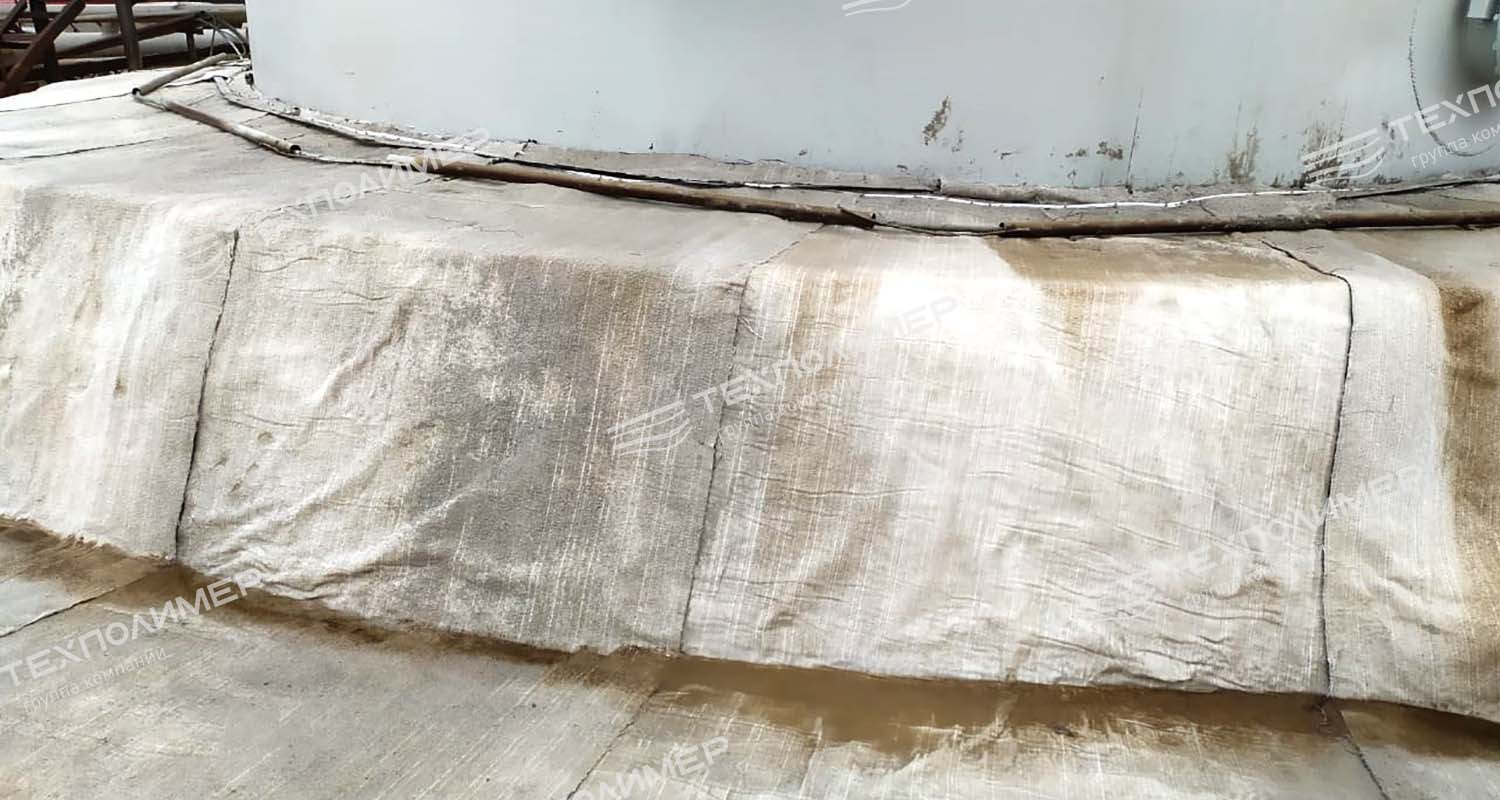
The bunding technology using concrete canvas makes it possible to create durable and reliable protection against flooding and chemical contamination in the shortest possible time and at minimal cost. It prevents spills and the penetration of chemicals into the soil, and also prevents the spread of fire in the event of a fire.
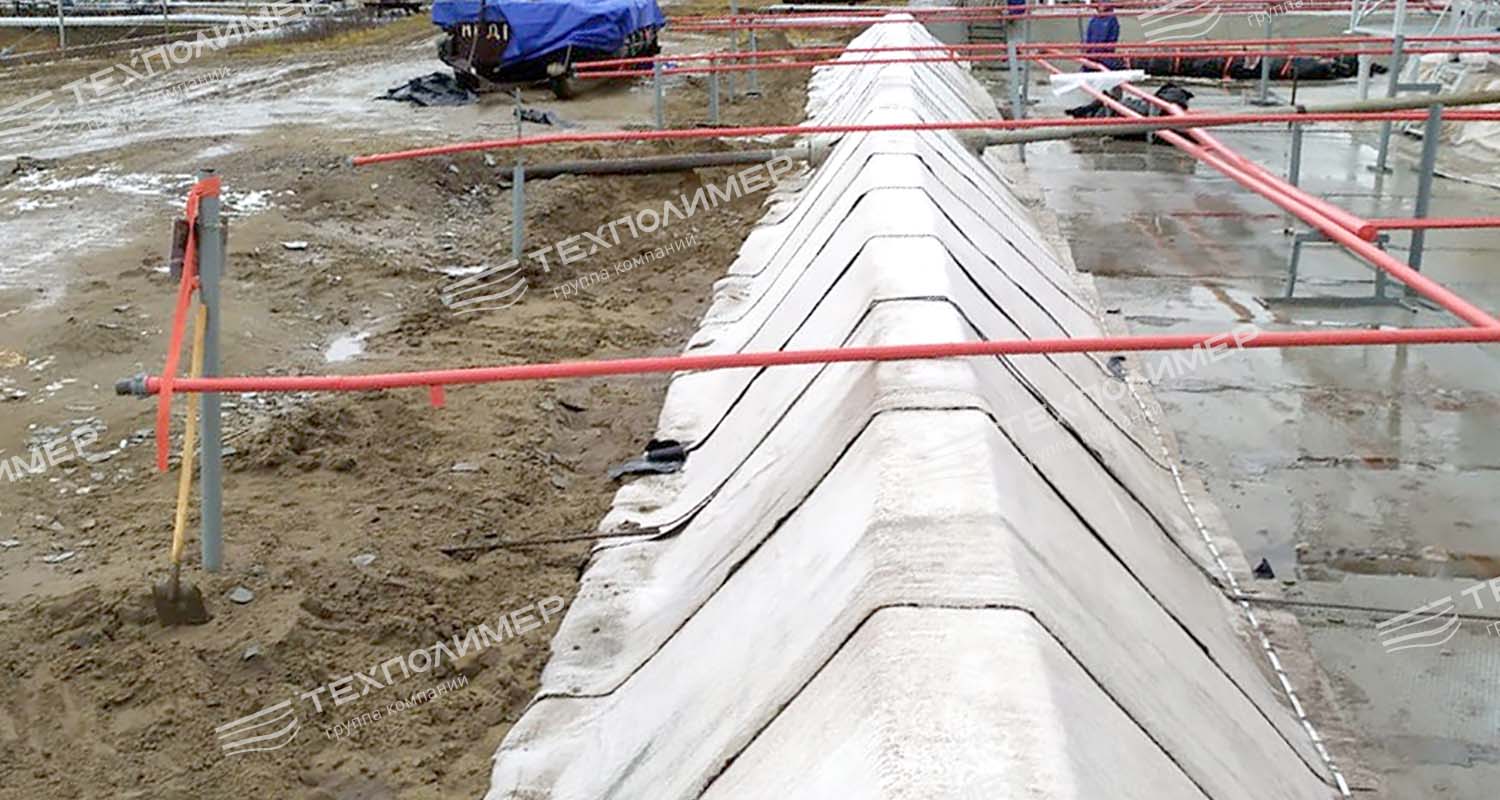
Using concrete canvas for bunding facilities of various purposes significantly reduces project implementation time and improves the reliability, durability and safety of the structure. It also offers a number of advantages over traditional technological solutions:
• Chemical resistance to alkalis, acids, petroleum products and solvents
• Flexibility and ability to conform to the shape of the base surface
• Waterproofness and environmental safety
• High crack resistance and load resistance
• The material does not support combustion
• Long service life
Observations during the operation of facilities using concrete canvas demonstrate the effectiveness of the technology: concrete canvas fully performs its engineering protection functions, ensuring safe operation of the facility for many years.