It was decided to modernize the road network במסגרת the Federal Target Programme “Socio-Economic Development of the Republic of Crimea and the City of Sevastopol through 2020”. One of the roads built under this programme was the R-260 “Tavrida”, connecting the cities of Kerch and Sevastopol.
During the fourth stage of construction, while establishing the designed longitudinal road profile near the village of Zuya, a karst cave at least 1.5 million years old was discovered.
The cave was examined by speleologists, who found skeletons of various ancient animals inside, so the option of filling it in was immediately ruled out.
At the instruction of Sergey Aksyonov, Head of Crimea, a specialised working group was established to review the proposed technical solutions. The assessment of the proposed options resulted in the selection of a solution with a reinforced-concrete distribution slab resting on 85 (95 according to other sources) bored piles.
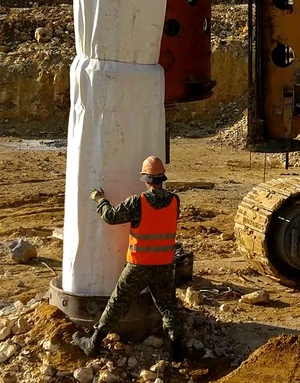
However, even this seemingly standard and proven solution required modification in this situation. The limestone structure of the cave walls and the road foundation was intersected by large cracks and voids, creating two additional problems: significant concrete overconsumption and the possibility of concrete entering the cave. In standard construction practice, these problems are addressed using casing pipes left in the ground; however, delivering them to the site would have created an additional burden on the peninsula’s roads, which are already heavily overloaded during the tourist season. The design organisation proposed an alternative solution: using high-strength seamless geosynthetic sleeves. The sleeve strength was selected specifically for the maximum load from the column of concrete.
- The “TEKHPOLYMER” Geopile is a seamless woven cylindrical geosynthetic shell with radial strength of up to 1000 kN/m, manufactured using circular weaving technology with high-strength polymer threads.
Until recently, there was no production of similar material in Russia. However, in line with the national import substitution programme, TEXPOLIMER Group opened production of woven geosynthetic sleeves at its production site in the city of Uzlovaya. The material was named Geopile.
The use of Geopiles solved the logistics problem: only 1 vehicle was required for delivery instead of 35–40, and there was no need to weld the pipe sections together, which further reduced construction costs. Only one technically simple operation had to be added: fitting the sleeve over the reinforcement cage.
Before the Geopiles were delivered to the site, the contractor had poured 3 piles directly into the ground without any casing pipes or sleeves. The mixture overconsumption amounted to more than 65% of the geometric borehole volume.
A TEXPOLIMER specialist was sent to the contractor’s company to provide installation supervision, train employees and monitor the installation process. Initially, the greatest difficulties arose when fitting the sleeve over the reinforcement cage, but soon, by optimising the crew composition and selecting the most effective installation method, it was possible to reduce the time required by 2.5 times. After several piles had been installed using sleeves, it became possible to collect data on cement mixture consumption: overconsumption amounted to no more than 7%, which was explained by the sleeve stretching under the pressure of the concrete. After the piles had been installed in the area of the cave alignment, a speleological inspection of the walls and ceiling was conducted: no cement penetration was detected.
Every third pile underwent control static testing: no difference in the load-bearing capacity of the Geopiles and the control piles without sleeves was detected. The Geopiles successfully passed the test.
Practice shows that the use of modern technologies in road construction is key to solving the most complex structural challenges, especially when the preservation of historical and natural monuments is at stake.
- Geopiles are used to construct vertical sand, crushed-stone and bored piles as a system for strengthening weak soil foundations, as well as in karst areas.