{"entity_title":"New Hydraulic Engineering Structures Using Geosynthetic Materials in the Development of Deposits in the Far North","field":"author","model":"publications.article","part":1,"parts_total":1,"source_pk":10,"source_text":"
S. N. Dolgikh., Head of the Hydraulic Engineering Department at the «Yakutniproalmaz» Institute, PJSC AK «ALROSA»;
\r\nA. N. Putivsky., Technical Director of «TEXPOLIMER» Group
Abstract. Modern design solutions using geosynthetic materials are presented, enabling the construction of hydraulic structures in permafrost conditions and where fill materials are in short supply, while also significantly reducing construction time. Using the construction of a bucket-type water intake as an example, the effectiveness of geosynthetic materials as a seepage-control barrier for construction on permafrost soils is substantiated.
Natural and climatic features of the deposits
Surface watercourses are the only source of water supply when developing deposits in the Far North. Experience operating dams on permafrost has demonstrated their high cost and high operating expenses; however, because direct water intake from rivers is difficult due to their freezing, artificial water bodies must be created. Such designs have been used in the water supply systems of the settlements of Mys Shmidta, Dikson, Barentsburg and others.
The new diamond deposit of PJSC ALROSA at the V. Muna River is located in the Olenyok District of the Republic of Sakha (Yakutia), 160 km northeast of Udachny and 180 km southeast of Olenyok, in the western part of the republic, between 70 and 65°N and 106 and 122°E (Fig. 1). The climatic zone for deposit development is 1A. The design outdoor winter temperature is −57 °C. The deposit territory is located in the zone of continuous permafrost distribution. The design depth of seasonal thawing in such soils varies from 1.3 to 4.5 m.
The geocryological conditions of the survey area have an ambiguous effect on the engineering-geological conditions. On the one hand, where geocryological conditions change little, mine workings are stable; on the other hand, the presence of ice inclusions significantly complicates the engineering-geological conditions. Even a short-term, minor change in temperature conditions causes ice to thaw and results in complex deformations of the rocks.
Preliminary design options for hydraulic structures
During preliminary design studies, specialists from PJSC ALROSA considered the construction of a conventional dam-type hydraulic system with a shore-based tubular spillway, as well as a shore-based bucket-type water intake with seasonal filling, based on the water supply requirements of the deposit during the winter period.
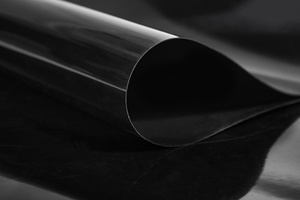
A comparison of the estimated costs showed that the dam option was almost three times more expensive than the bucket-type water intake. Therefore, for the construction of the first temporary water storage facility for supplying water to survey personnel in 2015, preference was given to the shore-based bucket-type water intake option, using geosynthetic materials as a seepage-control barrier, specifically a geomembrane (Figs. 5, 6).
In accordance with regulatory documents and the recommendations of geosynthetic material manufacturers, installation of a geomembrane seepage-control barrier required a 0.3–0.5 m-thick soil bedding layer, cleared of stones and sharp inclusions with a diameter exceeding 5 mm. However, conventional fine-grained, non-cohesive soils (sand or sand-and-gravel mix) required for preparing the base for geomembrane installation were unavailable at the construction site.
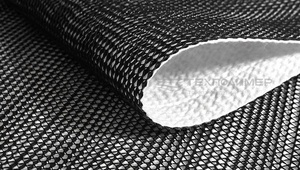
Engineers from TEXPOLIMER Group proposed using the geocomposite mat HYDROMAT 2D (STO 56910145-005-2011) as an alternative to the conventional soil bedding layer. It consists of a high-strength three-dimensional polymer grid coated with nonwoven geotextile (Fig. 3). Under load, HYDROMAT 2D can retain its thickness and undergo only minor compression, allowing it to be used as a cushioning layer that levels the surface and prevents damage to the geomembrane. Pilot-scale tests were conducted to confirm the feasibility of using HYDROMAT 2D as a replacement for the bedding layer, after which its use was approved.
The seepage-control barrier design for the temporary water storage facility was as follows: polymer sheets (TEXPOLIMER geomembrane) made of high-density polyethylene (HDPE), 2 mm thick, were laid over a layer of HYDROMAT 2D geocomposite mat (Fig. 4). This design solution helped reduce the duration of earthworks and overall construction, which is particularly important given the short construction season in the northern region.
Two years after the first temporary water storage facility was commissioned at the deposit, the bucket-type water intake using geosynthetic materials as a seepage-control barrier had proven reliable. In 2017, it was therefore decided to design a reservoir with a dam and spillway on Bezymyannyi-1 Creek using the same principle (Fig. 2).
At the normal retention level of 319.50 m (absolute), the total volume of the water body is 129.07 thousand m³, including a useful volume of 115.47 thousand m³ and a dead storage volume of 13.6 thousand m³. During the spring flood period, the facility is filled through the operation of inlet and outlet channels no more than 15 m long (Fig. 2).
The standard construction period for similar facilities is 29 months; all reservoir structures were completed significantly faster, in 24 months. Earthworks using drilling and blasting were carried out only during the winter period, from October 2017 through April 2018 inclusive, and resulted in the following:
- excavation volume: 257 thousand m3;
- embankment volume: 88.5 thousand m2;
- grading volume: 90.7 thousand m2.
Surface grading and installation of TEXPOLIMER geosynthetic materials were carried out from the end of March to the end of April 2018 on a 1 m-thick layer of rock soil with an average fraction diameter of 40 mm. The work was carried out around the clock in two shifts (Figs. 7, 8).
During installation, the geomembrane sheets were joined using thermal welding, forming a double seam with a test channel. The sheets were welded using two main types of equipment manufactured by the Swiss company LEISTER: the TWINNY T hot-air welding machine and the WELDMAX hand extruder. Upon completion of the welding, seam tightness was checked by applying excess air pressure to the test channel.
Disused reinforced-concrete products—support pads for temporary power supply lines—were used as ballast to prevent the geomembrane from floating. The facility was filled during the flood period in May–June 2018 (Fig. 9).
Conclusion
The project received a positive conclusion from a non-governmental expert review and was implemented within the shortest possible time.
The use of modern geosynthetic materials significantly reduced the cost and construction time of the hydraulic structures, while also minimising the impact on the environment of Bezymyannyi-1 Creek and the V. Muna River in the construction area.
Further operating experience with such structures will support the improvement of design solutions and may serve as an example for constructing water intake facilities on permafrost soils.