Sergey Borisovich Zemlyakov, Chief Specialist CJSC «TEXPOLIMER»
Construction of facilities located away from centralised sewerage systems requires a solution for collecting, treating and disposing of surface runoff. Traditional methods, such as constructing extensive networks or using storage tanks followed by pumping, are often economically inefficient and environmentally unsafe. This article examines alternative solutions that comply with current regulatory requirements and ensure high efficiency.
Isolated construction sites need autonomous drainage systems where no centralised stormwater sewerage is available.
The main challenges include:
- No discharge points into water bodies, requiring either extensive networks with pumping stations or storage tanks with removal by tanker vehicles.
- Overloading of urban stormwater networks by large facilities (logistics complexes, industrial sites), aggravated by ageing infrastructure.
- Strict regulatory requirements for runoff quality. For discharge onto the terrain or into infiltration systems, runoff must meet the parameters for “building roofs”:
- Suspended solids: <20 mg/dm³;
- BOD5: <10 mgO₂/dm³;
- COD: <20 mgO₂/dm³;
- Petroleum products: 0.01–0.7 mg/dm³.
- Prohibition on discharging contaminated runoff into water bodies and soil, requiring mandatory treatment.
At the same time, regulatory documents require the use of environmentally friendly solutions, such as:
- Rain gardens — for areas with low anthropogenic impact.
- Infiltration tanks — for local filtration of conditionally clean runoff.
Proposed technical solutions for collecting, treating and disposing of surface runoff
Modular above-ground and underground systems can treat runoff to the required parameters (for example, suspended solids <20 mg/dm³, petroleum products 0.01–0.7 mg/dm³). The configuration of the modular treatment system is selected for the specific site conditions and may include:
- mechanical treatment;
- oil separators;
- sorption filters;
- osmosis units;
- ultraviolet disinfection.
1.Modular treatment facilities in the form of an above-ground deep-treatment pavilion (see Fig. 1) are delivered to the site fully factory-assembled (with all engineering utilities, including heating, ventilation, lighting, power supply system and others).
Implementation example: The treatment facilities for supernatant water at the Baikal Pulp and Paper Mill (see Fig. 1) demonstrated the possibility of obtaining distilled water after treatment.
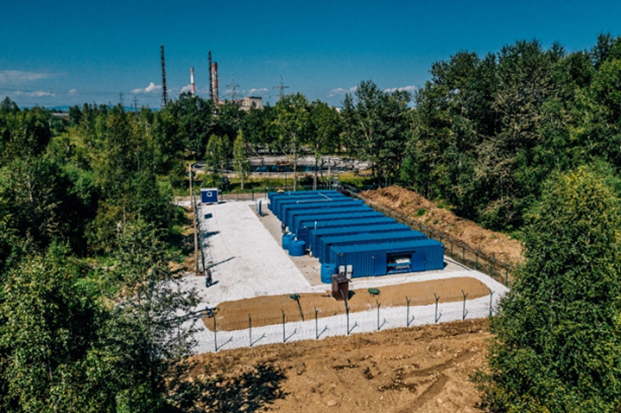
Fig. 1. Treatment facilities for supernatant water at the Baikal Pulp and Paper Mill.
The modular treatment system at the Baikal Pulp and Paper Mill consisted of mechanical treatment, two-stage osmosis, ion-exchange filtration and ultraviolet disinfection.
2.Underground modular treatment facilities are delivered to the site as prefabricated treatment systems AquaBOX-LOS, equipped with several treatment sections (see Fig. 2). AquaBOX-LOS is a system for collecting, treating and storing liquid sediments. A LOS normally consists of three components. The first is the runoff collection system itself, using channels and filter elements. The second LOS compartment usually contains filters for mechanical removal of coarse contaminants. The third compartment contains fine filters for removing fine contaminants from wastewater.
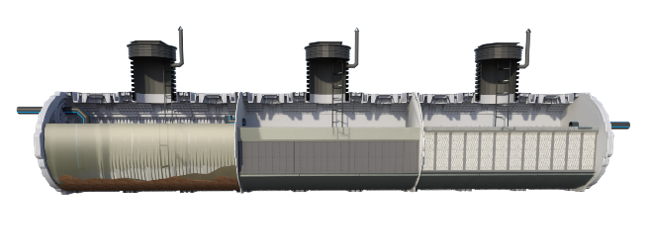
Fig. 2. AquaBOX local treatment facilities with three treatment stages (sand separator + oil separator + sorption unit).
“BlokTech” infiltration tanks and rain gardens
For conditionally clean runoff from building roofs, the following can be used:
- Rain gardens — are artificial depressions in the terrain filled with filter layers and plants that retain, treat and infiltrate runoff (see Fig. 3).
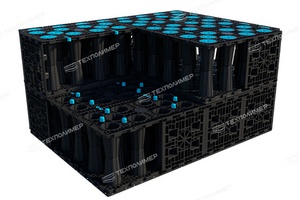
- “BlokTech” modular tanks TU 22.29.29-014-56910145-2018 — rapidly assembled polymer underground tanks for storing and infiltrating water into the soil without using heavy equipment.
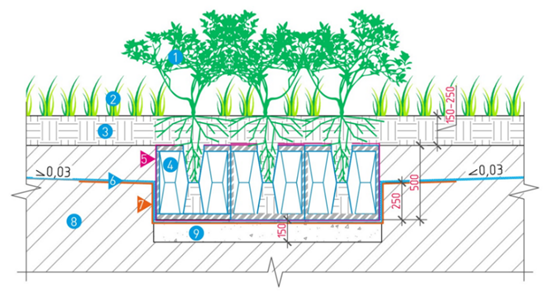
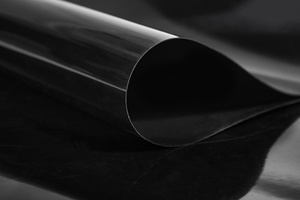
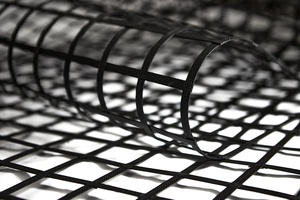
Fig. 3. Rain garden design: 1 – perennial ornamental plants; 2 – perennial grass seeding over the fertile soil layer; 3 – fertile soil layer; 4 – “BlokTech” modular tank; 5 – geotextile; 6 – Type 5/2 geomembrane; 7 – 3D hydromat; 8 – foundation soil; 9 – levelling layer of crushed-stone-and-sand mixture S6.
Implementation example: At Kemerovo Airport, the use of prefabricated polymer modular tanks (see Fig. 4) reduced installation time by 3.6 times (from 263 to 72 days) and eliminated operating costs for scheduled repairs during the period under review.
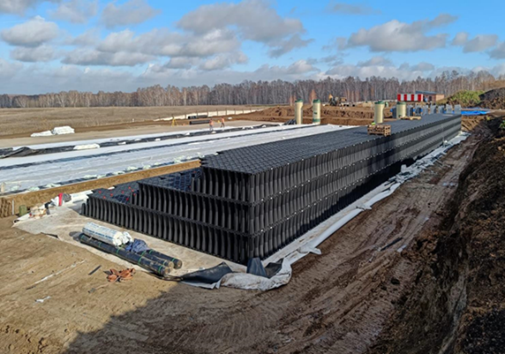
Fig. 4. Installation of a prefabricated polymer modular tank at Kemerovo Airport.
Comparative analysis
Table 1 presents data on labour input and operating costs for the construction and operation of a reinforced-concrete storage tank and an alternative solution – the “BlokTech” polymer modular tank.
|
Table 1 Comparative analysis of technical and economic indicators for tank construction |
||
|
Parameter |
Reinforced-concrete tank |
Prefabricated polymer modular tank “BlokTech” |
|
Labour input |
105 302 man-hours |
5 737 man-hours |
|
Construction period |
263 days |
72 days |
|
Operating costs (10 years) |
+10 420 000 RUB |
0 RUB |
Advantages of modular tanks:
- Service life of “BlokTech” modules ≥50 years.
- No corrosion or need for maintenance work.
- Minimal environmental impact.
Conclusions
1) Modular treatment facilities provide a high degree of treatment for runoff and can be adapted to specific conditions.
2) “BlokTech” infiltration tanks and rain gardens reduce construction and operating costs, in line with sustainable development principles.
3) The use of these technologies reduces the load on urban networks and minimises environmental risks.
Conclusion
Implementing modern solutions for treating surface runoff at isolated construction sites makes it possible to combine economic efficiency with environmental safety. These technologies should be considered when designing new facilities and reconstructing existing drainage systems.