Geosynthetic materials are being increasingly used in a wide range of industrial, civil and transport construction applications. Their use in the road sector is expanding significantly. Moreover, in recent years, the volume and range of geosynthetics manufactured by domestic producers have continued to increase. Scientific research helps determine the effectiveness of their use.
Under current road pavement design and calculation practices (ODM 218.5.002–2008), it is accepted that incorporating a geogrid into a road pavement structure strengthens the pavement and prevents the interpenetration of materials in adjacent layers. Strengthening is achieved through the combined action of the geogrid and the discrete material of the base or transitional-type surfacing, resulting in interlocking, i.e. restricting the movement of individual grains of this material within the geogrid apertures. It is considered that the resulting composite layer «discrete (granular) material + geogrid» should have improved mechanical properties and, above all, — a higher deformation modulus than an unreinforced layer of discrete material.
As is known, the deformation modulus of a layer (structure) is determined from the results of compression tests or soil plate-load tests under static loading in a test pit or borehole. To ensure reproducibility and maintain constant such factors as soil moisture, compaction technology, etc., the tests were conducted under laboratory conditions, in accordance with the requirements of GOST 20276–99.
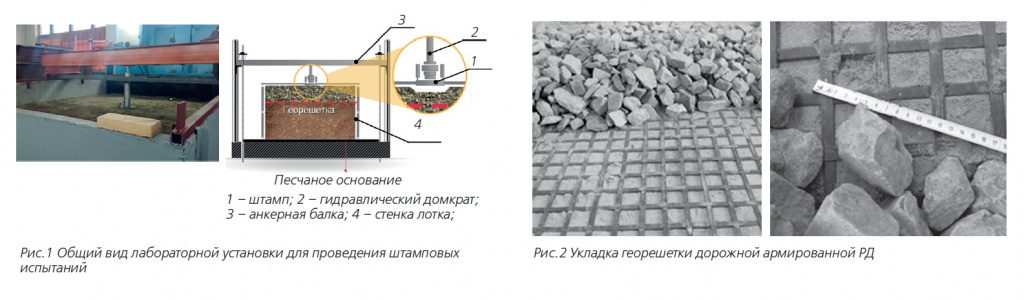
During the experimental studies, the overall deformation modulus of the base was determined in a soil test box placed in a concrete enclosure with internal plan dimensions of 3,40 m x 2,00 m and a height (depth) of 1,40 m (Fig. 1).
The soil test box was filled with fine sand at optimum moisture content (14%), with an angle of internal friction φ1 = 28° and specific cohesion c1 = 0,4×10⁻² MPa. The sand was placed in 0,15 m layers. Each layer was compacted using a vibrating plate and a special manual tamper-plate dropped from a height of 0,40 m. During sand placement, its density throughout the thickness and plan area was controlled by sampling with standard rings. The compaction method used ensured a uniform base density of ρ= 1,7 t/m 3.
A crushed-stone base (surfacing) was constructed over the sand subbase using the wedging method in accordance with SNiP 3.06.03–85. The crushed-stone base (surfacing) was constructed in the following sequence:
- placement of the main crushed-stone fraction (graded crushed stone 40–80 mm, grade 1000, group 1 in accordance with GOST 8267–93) and its preliminary compaction;
- placement of the wedging crushed stone (two-stage wedging: graded crushed stone 10–20 mm and 5–10 mm, grade 1000, group 1 in accordance with GOST 8267–93), with each fraction compacted. The thickness of the crushed-stone layer in its compacted state was 20 cm.
After the overall deformation modulus had been determined on the surface of the crushed-stone base, the layer was dismantled and the geogrid under study was placed at the interface between the crushed-stone and sand base layers (Fig. 2). The procedure for constructing the discrete layer reinforced with the geogrid was performed in the same sequence as described above.
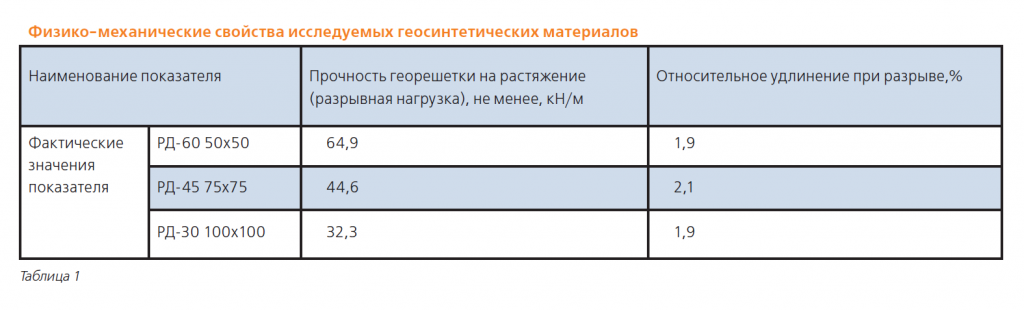
The reinforcing material used was a geosynthetic material that had recently appeared on the market and was unfamiliar to the domestic road sector: RD reinforced road geogrid (hereinafter referred to as RD). The physical and mechanical properties of the geosynthetic materials under study are presented in Table 1.
The geogrid ribs are formed by six spring-wire strands covered with a low-pressure polyethylene sheath (Fig. 3). To assess the effect of the structural and geometric parameters of the geogrid tested, material specimens with different aperture sizes (from 50×50 mm to 100×100 mm) were produced, which affected the tensile strength of the material specimens used. The results of the experimental studies are presented in Fig. 4.
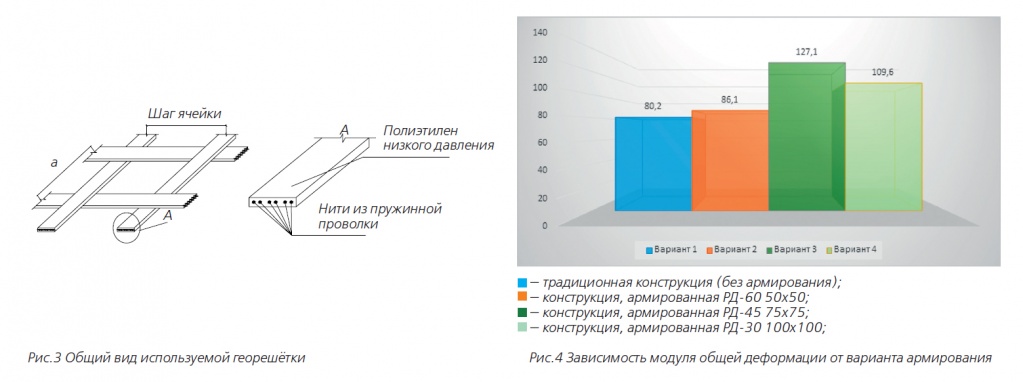
The studies showed that using RD reinforced road geogrid to reinforce a discrete layer increases the overall deformation modulus by 7% to 59%, depending on the structural features of the material used. Based on the comparative test results, it can be concluded that using RD-45 75×75 geogrid reduces the total settlement of the plate (under equal external loads) by 36%, while the resulting composite layer «discrete material + RD-45 75×75 geogrid» has an overall deformation modulus 59% higher than the «traditional» (unreinforced) layer of discrete material.
It should be noted that the effect obtained by reinforcing a discrete layer depends not only on strength characteristics but also on the structural and geometric parameters of the materials used (aperture size).