Author: Sergey Borisovich Zemlyakov, specialist at «TEXPOLIMER»
Large-scale road infrastructure construction and the impact of negative natural (climate), physical (erosion) and chemical (aggressive environment) factors on water conveyance structures make the protection and service-life extension of reinforced-concrete water conveyance structures a relevant issue.
This article examines an example of the construction of water conveyance pipes from lined reinforced-concrete sections at the following facility: “Major repairs to the R‑255 “Siberia” highway, Novosibirsk — Kemerovo — Krasnoyarsk — Irkutsk, section km 852+000 — km 878+000, Krasnoyarsk Krai”. The water conveyance pipes (at PC88+04,61 and PC27+53,96) will operate to convey a permanent watercourse with a high water flow rate, making it possible to compare them with hydraulic structures. The reinforced-concrete sections of the water conveyance pipes were developed and manufactured on the basis of standard series, comply with the specific required watercourse flow-capacity parameters and were adapted to incorporate innovations — namely, a protective lining made of polymer anchor sheet (TU 2246–003–56910145–2014) manufactured by ZAO “TEXPOLIMER”.
Material selection
When selecting engineering solutions for the water conveyance pipes, a comparative analysis was carried out of the total construction and operating costs of structures made from standard and lined reinforced-concrete blocks. The calculation for the rectangular reinforced-concrete pipe at PC27+53,96 showed that using lined blocks reduces construction and operating costs over 24 years by 2.5% (this figure is achieved through an 82% reduction in current repair and maintenance costs).
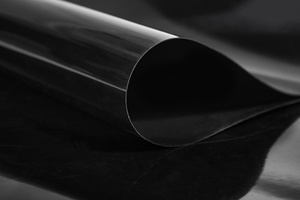
The polymer anchor sheet TU 2246–003–56910145–2014 provides continuous waterproofing and protects reinforced-concrete structures and their elements from corrosion. In addition, polyethylene has the lowest abrasive wear value according to the Darmstadt test (100 000 cycles): concrete — 0,40 mm; steel — 0,70 mm; fibreglass — 0,34 mm; high-density polyethylene (HDPE) — 0,070 mm.
This coating makes it possible to extend the service life of the pipe, increase intervals between repairs and improve structural reliability. HDPE is resistant to ultraviolet radiation and environmentally safe: it does not release any toxic substances and can be used in structures that come into contact with drinking water.
Based on the data obtained, the solution for constructing water conveyance pipes on the R‑255 highway from lined blocks was included in the design documentation, received a positive conclusion from Glavgosekspertiza and was approved by the client for implementation.
Construction works
To implement the project, TEXPOLIMER manufactured and supplied prefabricated reinforced-concrete blocks for the pipe body to the construction site in accordance with individual specifications. The surfaces of the blocks in contact with water were lined with polyethylene sheet.
At PC27+53,96 of the R‑255 “Siberia” highway section, the design provided for a single-cell rectangular pipe 36,77 m long, with a cross-section of 4,0×2,5 m and a longitudinal gradient of 5‰.
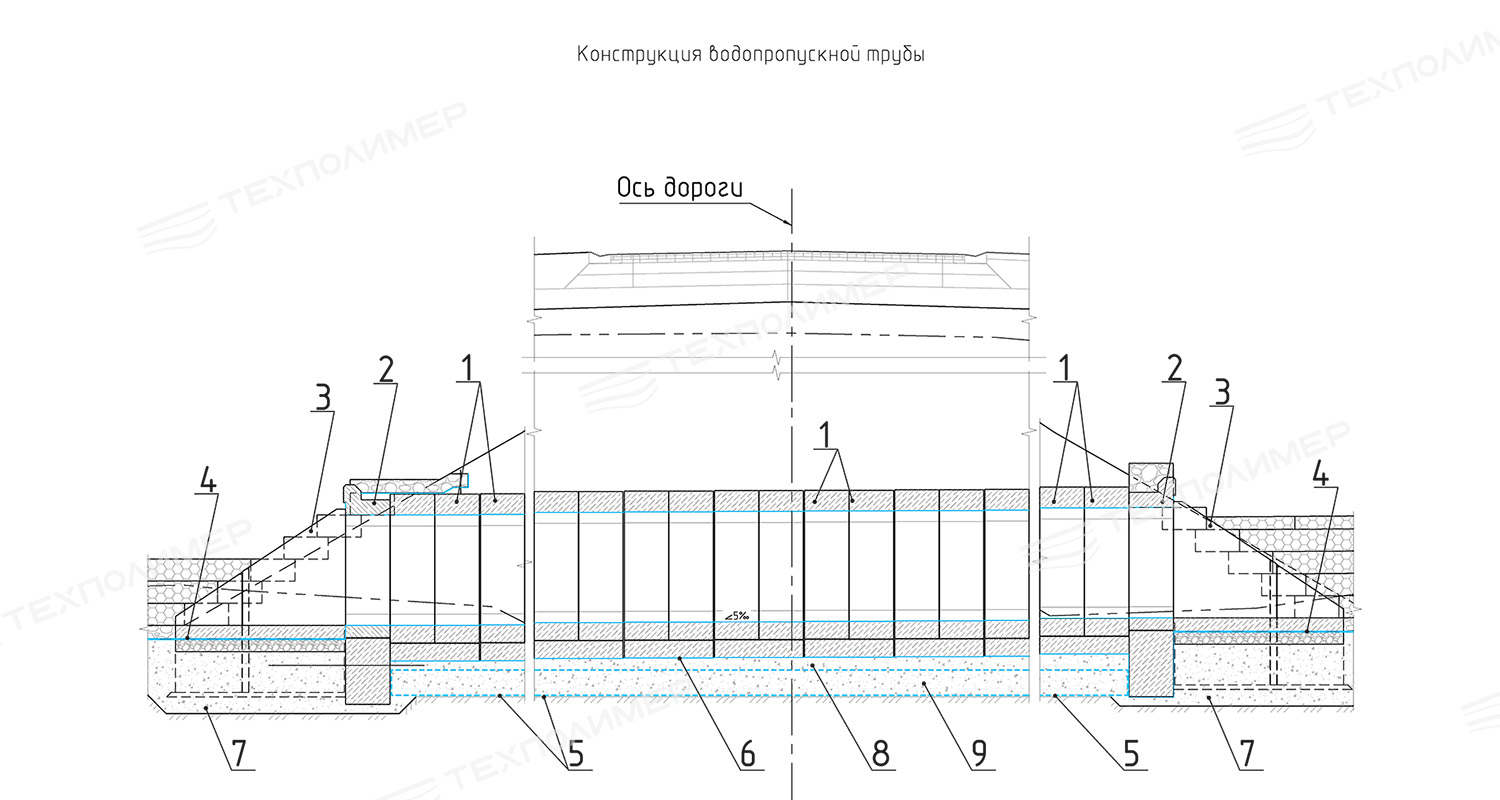 Design diagram of the water conveyance pipe at PC27+53,96: 1 — lined section; 2 — lined headwall section; 3 — lined wing wall; 4 — geomembrane; 5 — RD geogrid; 6 — geotextile; 7 — gravel-and-sand cushion; 8 — ЩПС cushion beneath the pipe body; 9 — ЩПС backfill around the enclosed sections
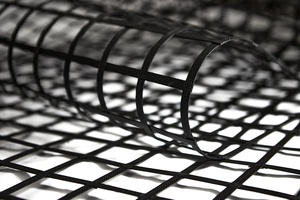
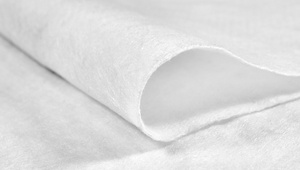
The pipe was assembled from portal and wing-wall blocks and pipe sections. Due to the low quality of the local soil, the foundation beneath the pipe was replaced with a ЩПС cushion reinforced with RD geogrid (CTO 30478650–001–2012). The embankment slopes and the channel at the pipe inlet and outlet are reinforced with gabion structures, waterproofed with Type 5/2 geomembrane (TU 2246–001–56910145–2014) and protected and drained on both sides with geotextile.
At PC88+04,61 of the R‑255 highway section, engineering surveys indicated the possible formation of aufeis on the permanent watercourse. To convey the watercourse beneath the road embankment, a new water conveyance structure was planned, with its body constructed from solid concrete blocks in accordance with the requirements of СП 35.13330.2011. The design provided for a pipe with a rectangular opening of 3,0×2,0 m and a body length of 52,02 m, with a pipe gradient of 20‰.
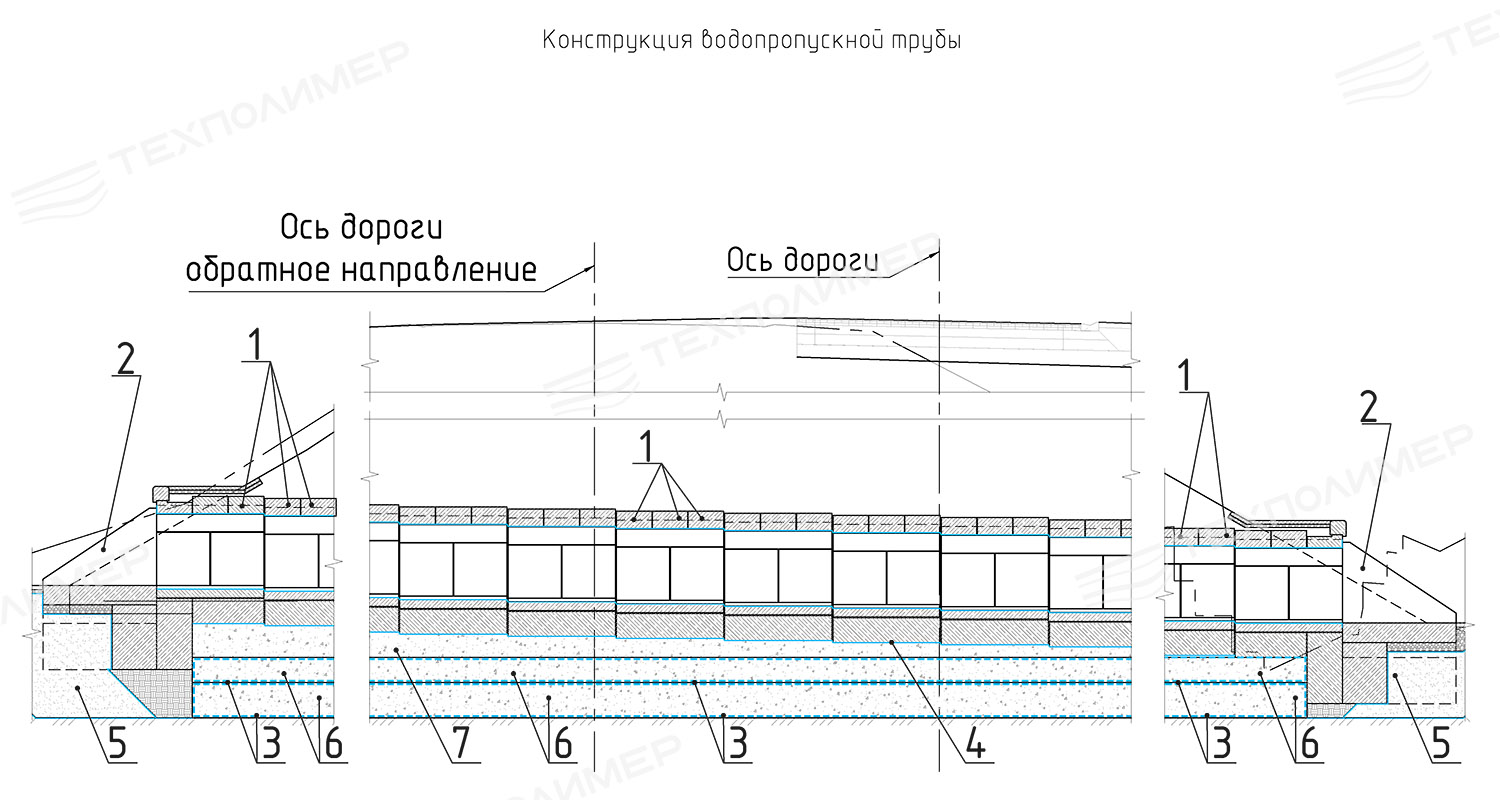 Design diagram of the water conveyance pipe at PC88+04,61: 1 — lined pipe-cover block; 2 — lined wing wall; 3 — RD geogrid; 4 — geotextile; 5 — ПГС backfill; 6 — ShPS backfill around the enclosed sections; 7 — ShPS cushion beneath the pipe body
To construct the pipe body, the weak local soil was replaced with ShPS reinforced by two closed enclosures made of RD road reinforcement geogrid (the lower enclosure was 1 m high and the upper one 0,7 m high). The pipe was assembled from lined wing-wall blocks, pipe-body wall blocks, crossbeams and cover blocks.
Specialists certified by NAKS were engaged to carry out the welding works. Their task was to create a continuous and completely watertight waterproofing layer on the inner surface of the pipe at the locations of the joints between sections. A special extruder and polymer rod were used to weld polymer strips to the lined pipe sections.
During the spring flood of 2024, the water conveyance pipe at PC27+53,96 on the R‑255 “Siberia” highway operated normally and performed its function.
Conclusion
Construction from prefabricated lined reinforced-concrete blocks provides:
- the ability to combine the manufacture of reinforced-concrete products with high quality in factory conditions and lining with anchor sheet;
- a significant reduction in structure maintenance and repair costs;
- longer intervals between repairs and an extended structural service life.
The specialists of the TEXPOLIMER group of companies have many years of experience in solving concrete protection challenges at facilities including water conveyance structures, hydraulic engineering structures and tanks forming part of wastewater treatment facilities, and are ready to cooperate.