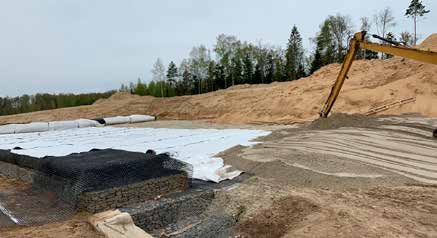
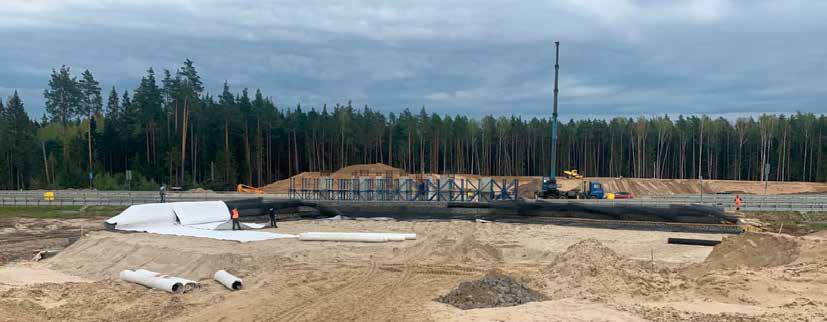
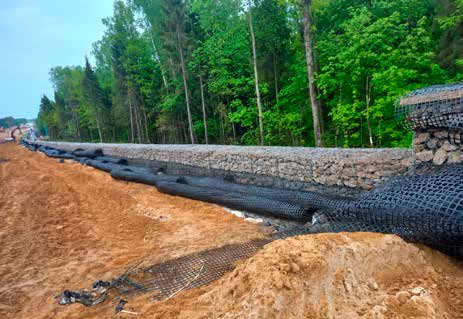
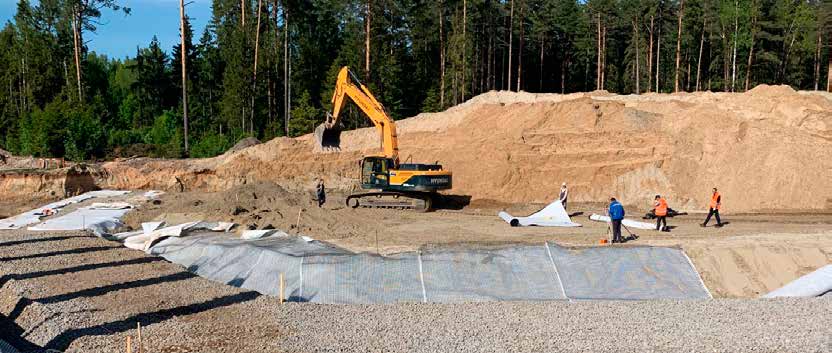
Road builders compare the M-12 expressway with a bridge built over karst caves, marshes, rivers and ravines. Yet during construction, it still resembles a river. Its bed is lined with a yellow strip of sand covered by a white geosynthetic sheet, reinforced with a metal mesh, strengthened with stones, filled with crushed stone and covered with asphalt concrete. Along the edges of the future highway, banks are now being built—a gabion wall. At the initial stage, the gabion structures are assembled using an innovative technology with a large amount of geosynthetic materials. We were able to see this for ourselves.
COVERING EVERY METRE “BY HAND”
Like a river, the future highway begins at the Central Ring Road. In the Moscow Region, 77 kilometres of highway are to be built; 64 kilometres make up the initial stage, passing through six districts of the Moscow Region—Lyubertsy, Balashikha, Bogorodsky, Elektrostal, Pavlovsky Posad and Orekhovo-Zuyevsky—bypassing towns and cities for residents’ convenience. This stage proved the most interesting and geographically accessible for us. Work on the first launch complex—from the Central Ring Road to the A-108 in Orekhovo-Zuyevo—has been underway since the end of 2020. The first launch complex, more than 20 km long, is located in the Bogorodsky, Pavlovo-Posadsky and Orekhovo-Zuyevsky urban districts.
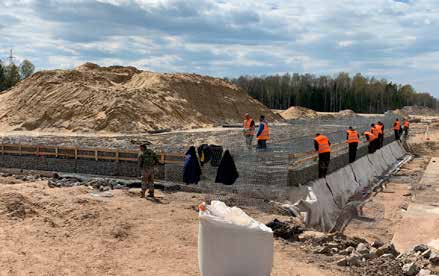
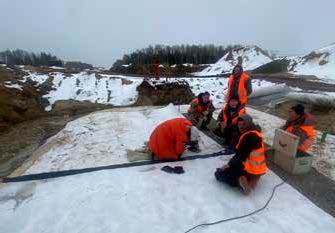
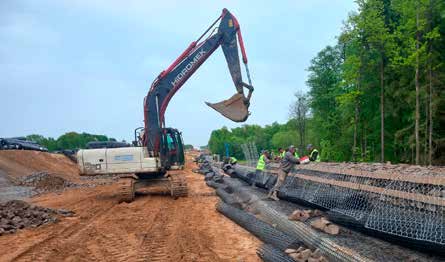
At the time of our visit, the Voronezh-based company “UDMS” was working on the first launch complex. Life here does not stop for a minute: wherever you look, there are dump trucks, excavators and people—people everywhere. Road builders were dressing and laying stones, cutting and wrapping geosynthetics... Every metre literally has to be laid by hand. We wanted to find out from people who had worked through the “fires, floods and pipes” of many federal construction projects what fundamentally distinguishes the M-12 from other expressways. And, incidentally, we journalists were always kept informed of developments.
The Voronezh team started work at its sites in the winter of this year. Everything was white and covered in snow. They plan to strengthen the future motorway with gabion structures in many sections of the initial stage. Three sites are currently under construction. Completion is approximately 80 percent. One of the sites we visited is located at kilometre post 442 near the settlement of Zatishye, while two are near the Orekhovo-Zuyevo bypass—sections IS37–IS38 km in the bridge contractors’ abbreviation. According to the plans, there will be approximately 12 sites at various stages as far as Moscow. For now, however, all the company’s resources are concentrated on the first three “pioneers”.
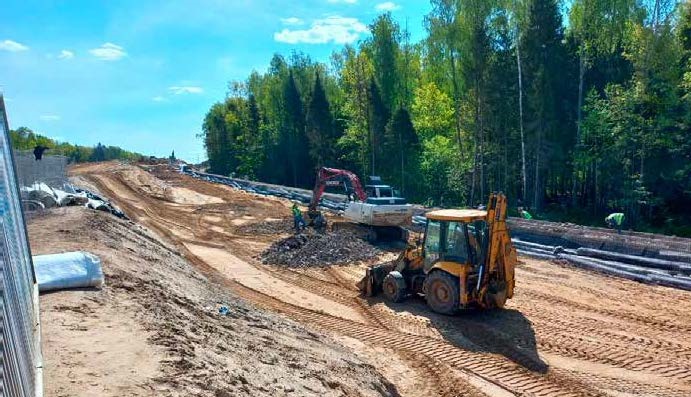
Most of the road had already been filled, as “UDMS” works closely with “TSM”. As soon as its specialists handed over the foundation, they began installing gabion structures—laying stones on a metal mesh. The general contractor also technically handled the filling and delivery of materials to the site, while simultaneously placing the fill in 13–14 cm layers. This is very painstaking work.
“That is how we work together around the clock,” said Sergey Ryazantsev, General Director of LLC “UDMS”, showing a chronological photographic record of stages we had not witnessed. “The work is approaching completion, and all work at the three sites should be finished by the end of July.”
More than 20,000 sq. m of geogrid and more than 60,000 linear metres of geosynthetic tape must be installed. There is a great deal of manual work, and on average more than one hundred people work at the three sites in two shifts.
“Most of them are our permanent team—the people from Voronezh,” Sergey Ryazantsev noted. “Overall, however, many people from different regions are working on the first launch complex. When constructing the foundation, we even had to bring in student teams because of the shortage of workers. For example, at one of the sites between two bridges, our team, the bridge builders and pipe-laying specialists all worked together. A great deal of machinery is involved—around 20 machines are currently operating at the three sites, while across the entire project more than 200 pieces of equipment are working simultaneously. Much of it is heavy equipment, as mountains of sand—tens of thousands of cubic metres—have to be transported.” Thus, rollers, dump trucks and graders are currently playing the leading role in this “orchestra”.
The “UDMS” base, construction camp and office are currently located in the settlement of Bolshiye Dvory, near the construction headquarters, where all current construction issues are coordinated and resolved.
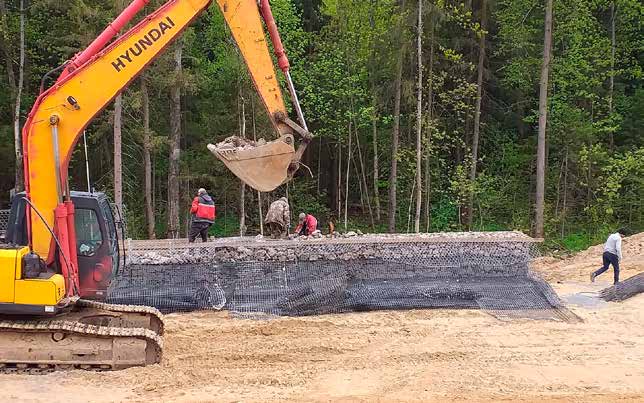
It should be noted that the best resources were assigned to the M-12—not only contractors, but also technology developers and construction-material manufacturers. This project has become a major step towards import substitution. For example, in Kazan, 5G technologies will be tested during construction of the M-12. According to Ayrat Khairullin, head of the Ministry of Digital Development of Tatarstan, they will be used by heavy trucks transporting large cargo flows. The road pavement will also be built to the highest standard. Innovations are being used in the construction of the pavement, foundation and gabions as well. Today, gabion structures are widely used in road construction, taking a well-established place among traditional methods of repairing and reinforcing road surfaces. However, innovative technologies are being used to install gabions on the M-12. The stone is supplied by the general contractor. It is transported from a long distance by rail to save on transport costs. The geosynthetics come from Krasnoyarsk, from the company “TEXPOLIMER”. They won the tender and developed the gabion construction design, so all the products are theirs as well, of very high quality and delivered precisely within the agreed deadlines.
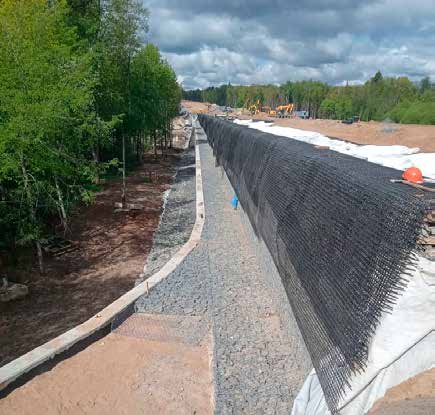
A large amount of geosynthetic material, including geosynthetic panels, is used at the initial construction stage. This is for building a strong and durable embankment, as there are many karst caves and marshes beneath the future road.
“At the Aksay Bypass, we made Reno mattresses of the mattress type for the embankment, while here the structure is new—a vertical gabion wall approximately 8.5 metres high. The result is a powerful horizontal reinforced embankment with ‘tails’ that are covered with sand. The technology is complex and new for us, but that is what makes it interesting, as geotextile is bonded to a plastic geogrid. In addition to the plastic geogrid, a steel core is also used,” the manager explained. “The geosynthetic material is delivered in rolls and coils, and we calculate every metre to determine how everything should be cut according to the design. A great deal of preparatory work was required for this—we had to obtain instructions and consult the plant’s specialists online about installation. In the end, the work got under way, and today no one does it better or faster than we do.”
Thus, all the builders share one goal: to complete everything to a high standard and as quickly as possible. Fortunately, the weather has now stabilised, and the work is progressing well. Last winter, however, there was heavy snowfall, so the sites were flooded in spring, and road builders had to battle the water around the clock, drying the area with manual pumps and more powerful attachments mounted on a Belarus tractor. Nevertheless, all deadlines were met and work is proceeding according to schedule. Work on the first launch complex—from the Central Ring Road to the A-108—will be completed this year.
“We are now moving from the first launch complex to the second, where we will also build gabion walls, but of a different shape and according to a different design,” said Mikhail Alekhin, site manager for the M-12 at LLC “UDMS”. “The second launch complex, from the North-Eastern Chord to the Central Ring Road, is also under construction. According to the plans, it is to be commissioned next year. So far, half of the designed work has been completed, and our walls adjoin the bridges, since the bridge abutments also need to be strengthened; at some artificial structures, the bridge builders are only preparing to begin work. As the second complex is not scheduled for commissioning this year, it is currently proceeding according to its own work plan and schedule, and it is impossible to say exactly how many kilometres we will have to cover.”
One thing is clear: this will be a comfortable six-lane expressway without traffic lights and of excellent quality. There will certainly be no funding problems. According to Marat Khusnullin, the country has sufficient funds for the construction of transport facilities; “there is also a future and a sufficient volume of work, but greater attention must be paid to construction quality.” Russian President Vladimir Putin also strongly urged that the red tape delaying the acceptance of sections be stopped. The road construction sector has been given the “green light”, and by building the M-12, Russia will once again prove to the world that it can handle any challenges without imported materials and technologies. And “UDMS”, as a long-standing partner of “TSM”, will once again confirm its competitiveness and reliability under any conditions and circumstances.
The article was prepared by the editorial team of the magazine “Roads and Transport” and published in the magazine “Roads and Transport, 6–7 2022” http://dortransport.com/