
Throughout the summer, numerous regions of the Russian Federation will hold large-scale trade fair and exhibition events called “Field Day”. This practice enables specialists to discuss current professional issues, exchange experience, demonstrate innovative agricultural technologies and showcase achievements across the sectors of the domestic agro-industrial complex.
The development of sector-specific solutions in the land reclamation segment plays a major role in improving land productivity. In 2023, the total sown area of agricultural crops across all categories in Russia was 81.203 million ha, while the area of irrigated land was only 4.69 million ha. At the same time, land reclamation canals in the Russian Federation were built more than 35–40 years ago and operated without substantial repairs. In other words, the land reclamation canal network is worn out and requires reconstruction using modern technologies and materials.
For example, creating an anti-filtration screen for an irrigation system using a “TEXPOLIMER” geomembrane with a “substrate” made of geotextile to protect the geomembrane from punctures can reduce water filtration losses by up to 35% and increase the structure’s flow capacity. In addition, thanks to its smooth surface, the polymer membrane has low adhesion and prevents bottom sediments and silt from settling.
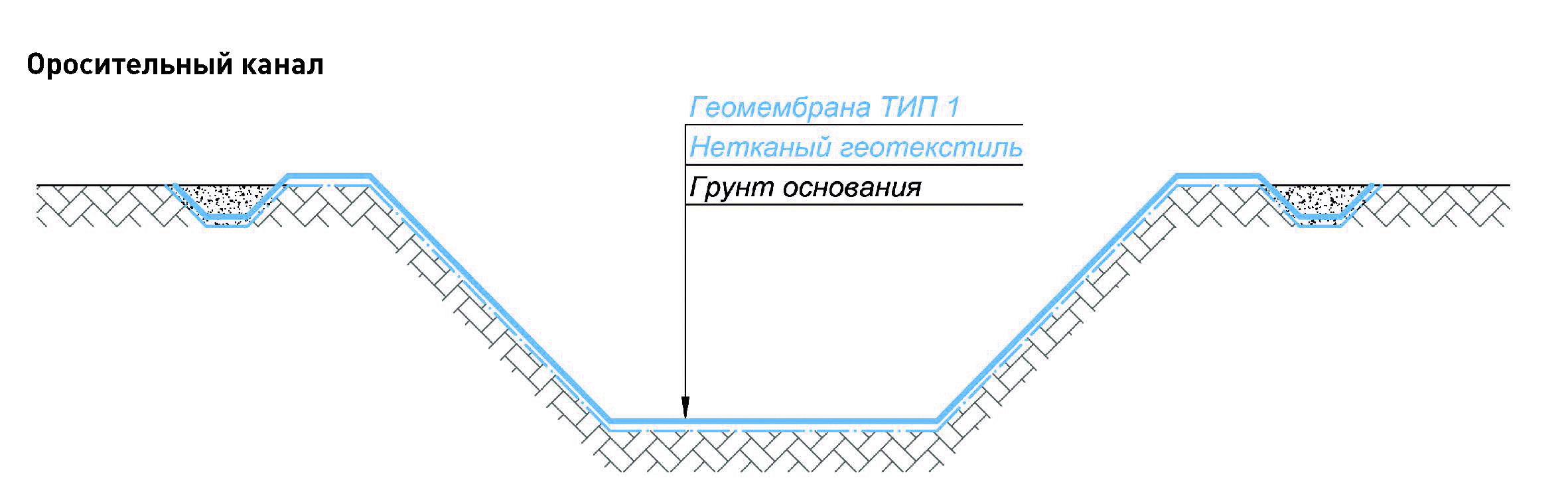
Compared with solutions made of concrete slabs, an irrigation system using geosynthetics is resistant to cracking and shrub growth, thereby increasing the design service life of the structure.
Accordingly, the use of geosynthetic and composite materials helps address the main problems of irrigation canals and storage ponds:
- eliminates water filtration losses;
- provides resistance to erosion of the structure’s foundation and slopes;
- prevents shrubs from overgrowing the canal bed;
- slows the formation of bottom sediments;
- significantly reduces canal construction time;
- substantially extends the service life of the structure.