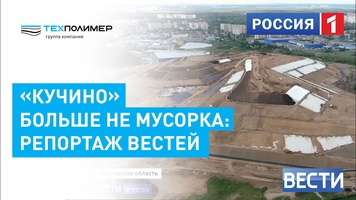
By the end of 2020, six previously closed municipal solid waste landfills in the Moscow Region will be remediated. Work at the Kuchino landfill has entered the final stage. One of the most challenging phases—the biological stage—is now nearing completion. The giant waste mound is being covered with a protective layer of fertile soil.
It is almost impossible to enter the Kuchino landfill. And not simply because it was closed three years ago. Due to the COVID-19 pandemic, employees have isolated themselves from the outside world and now live here in temporary cabins.
The pungent smell that poisoned Balashikha for years is now gone. After the landfill was closed, extensive remediation was carried out.
Across the landfill, 112 wells were drilled. Each is approximately 30 meters deep. They collect landfill gas generated inside the site. It then enters gas collection stations, after which it is sent for treatment and flared.
The flare unit processes 2,500 cubic meters of gas per hour. The temperature inside is 1,200 degrees.
“At such high temperatures, all harmful substances are destroyed. It is now clear that the volume is slightly lower; due to the strong wind, the temperature is higher. The system regulates the gas supply itself,”, explains Grigory Kolesnikov, operator of the Kuchino landfill’s flare unit.
The landfill body was reinforced with piles. Several protective layers were installed on top. First, geosynthetics, followed by a mixture of clay, sand and biomaterial.
“This is a layer of fertile soil approximately 10 centimeters thick, on which the biomat is unrolled. It is a flax fabric containing seeds,”, says Alexey Yakovlev, executive director of the contractor company Ecocom.
— Will there be grass here?
“Yes. As the flax fabric decomposes, it becomes a natural fertilizer for the grass,”, Yakovlev adds.
Another problem at the landfill is toxic leachate. It penetrates the soil and spreads in all directions. Drainage wells and boreholes were installed around the site to collect it. They collect the chemicals and send them to a treatment plant.
“The water is separated into two parts—dirty and clean—as it passes through a membrane. The dirty water is then sent to tanks behind the acid workshop. The clean water proceeds to further treatment,”, explains Sergey Losev, head of the Kuchino landfill section, describing the water treatment process.
Back in 2017, Balashikha residents protested against the landfill. Today, they closely monitor every stage of its remediation and say they can literally feel the positive results.
“It has become possible to breathe in Kuchino. Of course, we could not have imagined that we would manage to overcome the landfill, because it was the largest waste landfill in the country,”, says Kuchino resident Anatoly Batashev.
By the end of the year, five more closed landfills in the Moscow Region will be remediated: Dolgoprudny, Annino in Ruza, Dubna-Pravoberezhnaya, Knyazhi Gory and Kulakovsky in Chekhov.
“The Perekhodyashchee landfill is also currently operational. The facilities scheduled to be commissioned in 2021 are the Tsaryovo and Sliznevo landfills. And we will shortly begin remediation at the Valtsovo landfill. It is in Stupino,”, says Pavel Bida, Deputy Minister of Ecology and Environmental Management of the Moscow Region, outlining the plans.
There are currently 11 operating landfills left in the region. They will also be closed in the coming years. In their place, the Moscow Region plans to launch 12 waste processing complexes.