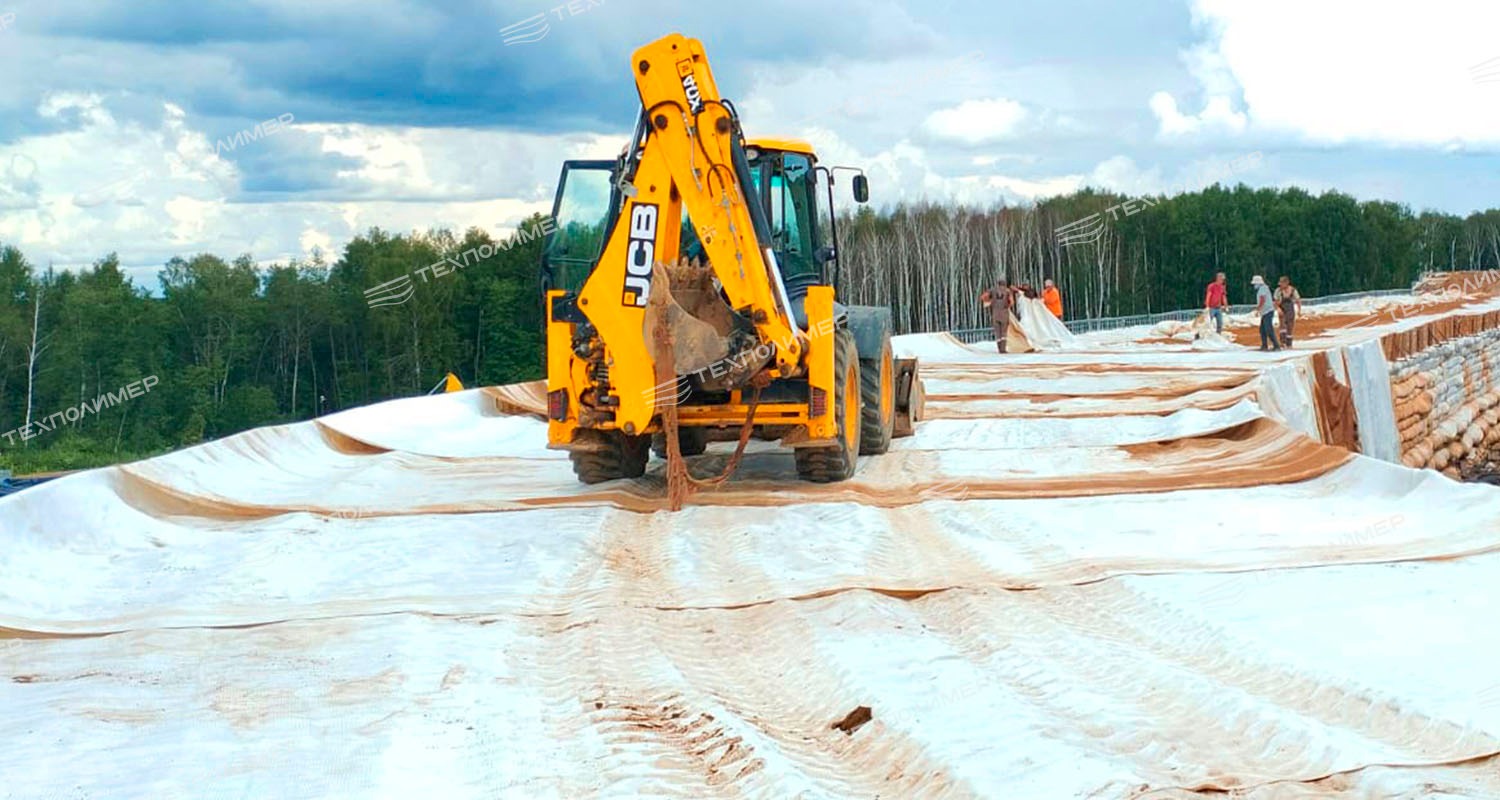
A new study by Perm National Research Polytechnic University (PNRPU) has, for the first time in Russia, quantitatively assessed the effect of geosynthetic reinforcement materials on the strength of logging roads. The results were published in the journal «Bulletin of the Volga Region State University of Technology».
Figures confirming effectiveness
PNRPU researchers developed a digital model of a two-layer transitional-type road pavement (crushed stone surface course + sand subbase) on weak soils — sandy loam, loam and clay. A geosynthetic layer was added at the interface between the subbase and the subgrade soil, after which the researchers assessed two key parameters: shear resistance and elastic deflection.
The modelling results showed:
-
Shear resistance of the road pavement using geosynthetics increased by 1.97 to 5.24 times depending on the soil type. The greatest effect was recorded on loam — the soil most prone to loss of stability when wet.
-
Elastic deflection decreased only slightly —by up to 1.9%, confirming that the primary function of the geosynthetic layer is to counteract shear deformations rather than vertical loads.
-
The higher the material stiffness, the more effective the reinforcement. The geosynthetic with a tensile stiffness of 800 kN/m produced a result that was 1.05–1.33 times higher than the material with a stiffness of 500 kN/m.
Why this matters to the industry
The methodology developed by the Perm researchers provides, for the first time, a quantitative basis for refining the regulatory framework. Engineers can now rely on precise data: for a specific soil type and reinforcement material characteristics, they can calculate in advance how many times the shear resistance of the road pavement will increase.
«TEXPOLIMER» expert opinion
The PNRPU study confirms what we observe in practice at thousands of sites across Russia: geosynthetic reinforcement is not merely an «additional layer», but an engineering solution with a measurable, predictable effect.
For applications requiring maximum shear resistance and reliable reinforcement of weak subgrades, our engineering centre recommends the woven geotextile «Stabigrunt».
«Stabigrunt» by «TEXPOLIMER»: structural reinforcement for critical facilities
«Stabigrunt» — a roll-form geosynthetic material manufactured by «TEXPOLIMER», consisting of a high-strength woven geotextile. The product is manufactured by joining longitudinal and transverse yarns at a 90° angle with additional stitching, providing high tensile and shear strength.
Key characteristics:
-
Evenly distributes loads in the longitudinal and transverse directions.
-
Resistant to chemicals, UV radiation and temperature fluctuations.
-
Extends the service life of structures and reduces operating costs.
Applications:
-
Reinforcement of subgrades for roads, railways and airfields.
-
Separation of layers in drainage structures.
-
Construction of retaining walls and protection of waterway banks.
-
Control of landslides and embankment deformations.
For more information about the material «Stabigrunt» and its technical characteristics, visit our website: [link to product page]