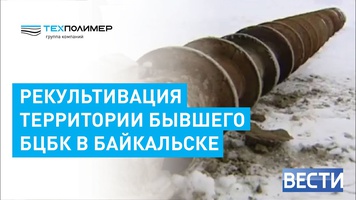
Preparations have begun in Baikalsk for the remediation of the territory of the former pulp and paper mill. Survey work is already underway at the industrial site, while proposals for technical solutions for remediating the Baikalsk Pulp and Paper Mill waste continue to be collected.
This is the treatment facilities site of the Baikalsk Pulp and Paper Mill. Once a town-forming enterprise. Today, it is a direct threat to Lake Baikal's environment. Almost 250,000 cubic metres of production waste, including toxic waste, have not gone anywhere. The only thing preventing it from entering the environment is the so-called «clay barrier».
— What is the dam made of?
— Clay. There is a hydraulic connection throughout. Here we have three ponds, two aeration tanks and the treatment facilities basement.
Attempts have been made three times to remediate the Baikalsk Pulp and Paper Mill waste. Different operators. «Rosatom» is the fourth. In November last year, the Russian Government instructed it to eliminate the hazardous legacy of the pulp mill. The process has begun, and representatives of the «Federal Environmental Operator» are showing experts from the People's Front how the work is progressing.
— As of today, four drilling rigs are operating at the treatment facilities site of the Baikalsk Pulp and Paper Mill. For now, they are taking soil samples from a depth of three metres, but they plan to drill deeper.
All samples will be sent to a specialised laboratory. Later, soil samples will be taken from a depth of 12 metres.
— Alongside the surveys and design work, priority measures will also be carried out here to lower the supernatant water levels in the Solzansky and Babhinsky waste ponds. We will begin this work as early as April this year. All preparatory work is currently underway, and the necessary equipment has been selected. It makes it possible to purify supernatant water to the level required by Order No. 83 of the Ministry of Natural Resources. In accordance with the established requirements, — says Andrey Lebedev, Director of the State Environmental Programmes Implementation Division at the «Rosatom» State Corporation.
Alongside the surveys, proposals for technical solutions for remediating the Baikalsk Pulp and Paper Mill waste continue to be collected. The best options will be discussed with scientists and environmental experts.
— Specific approaches to remediation have been identified. In principle, it is already clear what to do and how to do it. Following the surveys being carried out on the site, this set of approaches will be defined in the project. Essentially, the scientific and expert communities see clear and understandable systems that make it possible to remediate this territory, — says Alexander Kogan, an expert at the «Environment» thematic platform of the People's Front.
These are the Baikalsk Pulp and Paper Mill waste storage ponds. Covered with snow in winter, they look quite harmless. But they are the most hazardous of all, as they are filled with sludge lignin and ash and slag waste. Many people are interested not only in the remediation method, but also in what will happen to them afterwards.
— And where will this waste be discharged? I mean the supernatant water. In addition, there is bulky waste. Where will it be taken, to which landfills, and so on? Therefore, we will maintain continuous monitoring until all this waste has been processed, — says Sergey Apanovich, co-chair of the regional People's Front headquarters.
The technology is to be selected by 15 February. Together with scientists and Rosprirodnadzor, they will choose the most modern, effective and safe method for processing the waste. The project is also to be developed and approved this year. It will be implemented by 2024.
— Approximately 6.5 million tonnes of solid and liquid waste accumulated in the Baikalsk Pulp and Paper Mill storage ponds, located on the lake shore, during the 50 years of the mill's operation. Sludge lignin accounts for the largest share. In autumn 2020, the Government of the Russian Federation appointed the Federal Environmental Operator — an entity of the «Rosatom» State Corporation — as the operator responsible for eliminating the waste. It must complete the assigned task by 2024.
Preparations for reclamation of the former Baikal Pulp and Paper Mill site have begun in Baikalsk
12 February 2021